New York Air Guard Colonel Glyn Weir, a Cutchogue resident, retires after 34 years of service during June 6 ceremony
Weir was one of the first Combat Rescue Officers to serve in the 106th Rescue Wing
FRANCIS S. GABRESKI AIR NATIONAL GUARD BASE, WESTHAMPTON BEACH, N.Y. (06/11/2026) — New York Air National Guard Col. Glyn B. Weir, a Cutchogue resident and one of the 106th Rescue Wing's first Combat Rescue Officer (CRO), retired June 6, 2026, after 34 years of military service.
Weir was recognized during a ceremony at Francis S. Gabreski Air National Guard Base, in Westhampton Beach, New York.
Weir served in the Air Force's Guardian Angel community, an elite special operations organization whose Pararescuemen (PJs) and CROs specialize in finding, reaching and recovering isolated or missing personnel, military and civilian, under the motto "That Others May Live."
Weir began as a PJ, enlisting in the active-duty Air Force in September 1992 and completing pararescue school in March 1994.
Assignments followed at Patrick Air Force Base in Florida, Moody Air Force Base in Georgia, and the 24th Special Tactics Squadron at Pope Air Force Base, North Carolina, before Weir joined the New York Air National Guard's 106th Rescue Wing in 2003.
Weir joined the wing's 103rd Rescue Squadron shortly after it was established in 2003 and received his commission as a CRO in November 2004.
He was one of the first officers in that career field at the 106th.
Over the next two decades, his roles included director of operations, chief of tactics, commander of the 103rd Rescue Squadron, director of staff, and in May 2021, he became commander of the 106th Mission Support Group. Deployments in support of operations in Iraq and Afghanistan marked Weir's operational career as both a PJ and CRO.
NASA Space Shuttle launch and landing rescue operations and domestic disaster response missions during hurricanes Gustav, Harvey, Irma and Florence were also part of his service.
106th Rescue Wing commander Col. Jeffrey D. Cannet, who served alongside Weir for years and presided over the ceremony, said Weir's impact stretched well beyond any single assignment.
"His fingerprints are all over the 103rd and across the entire Guardian Angel enterprise," Cannet said. "He leaves behind a legacy of excellence, one that we should all be so lucky to emulate."
Retired Col. Shawn P. Fitzgerald, the prior 106th Rescue Wing commander, said one of Weir's defining qualities was a willingness to put the unit ahead of personal advancement. In the early years of the wing's 103rd Rescue Squadron, Weir actively recruited CROs who outranked him, knowingly delaying his own path to squadron command by nearly a decade.
"It was Glyn who put his unit ahead of himself and selflessly created a pool of more senior-ranking squadron officers from different backgrounds and perspectives that allowed the 103rd to really grow in its early days of existence," Fitzgerald said.
Retired Chief Master Sgt. Brian Mosher, who served with Weir for more than two decades, said that selflessness was consistent throughout the colonel's career.
"He has only one standard, and that standard is extremely high," Mosher said. "I have served with him, deployed with him, and watched him grow from a technical sergeant to a colonel, and I can tell you he's one of the best leaders and officers this Air Force and this wing have ever produced."
Family members, former PJs, fellow CROs, wing members and alumni from across the Guardian Angel community attended the ceremony.
Speakers throughout the program recognized Weir's wife, Michelle, and their children, Luke and Leah, as central to both the colonel's career and to the life of the wing's community. Michelle Weir has been active in family readiness programs and has led the volunteer team behind the wing's annual science, technology, engineering and mathematics (STEM) camp.
In 2023, the 106th Rescue Wing hosted the first Air National Guard STEM camp, a Department of Defense pilot program that Weir helped create and lead as Mission Support Group commander, and the wing has hosted the camp annually since.
Addressing his family directly from the podium, Weir reflected on what the journey meant beyond his own service.
"I've been lucky to have the love of my life by my side and raise two amazing kids along the way," he said.
Reflecting on three decades in uniform, Weir said the most valuable lesson came not from any technical skill but from the culture of the pararescue community itself.
"The greatest lesson pararescue ever taught me wasn't medicine, shooting, diving, parachuting, or mountaineering," Weir said. "It was trust. Trust your team, trust the people around you, and trust them to solve problems and to innovate."
That lesson carried directly into command of the Mission Support Group, where recruiting and retention were top priorities.
"I realized that the reason people join is for the mission," Weir said. "The reason they stay is for other people."
Among Weir's military awards are the Meritorious Service Medal with two oak leaf clusters, the Air Medal, the Aerial Achievement Medal, the Joint Service Commendation Medal with two oak leaf clusters, the Air Force Commendation Medal with two oak leaf clusters, the Joint Service Achievement Medal and the Air Force Achievement Medal with two oak leaf clusters.
The 106th Rescue Wing, based at Francis S. Gabreski Air National Guard Base in Westhampton Beach, New York, operates HC-130J Combat King II search and rescue aircraft and HH-60W Jolly Green II rescue helicopters. The wing is home to a Guardian Angel Squadron comprised of Combat Rescue Officers, Pararescuemen, SERE Specialists and Tactical Air Control Party Airmen who specialize in personnel recovery and deploy for domestic and overseas operations.
Media Attachments
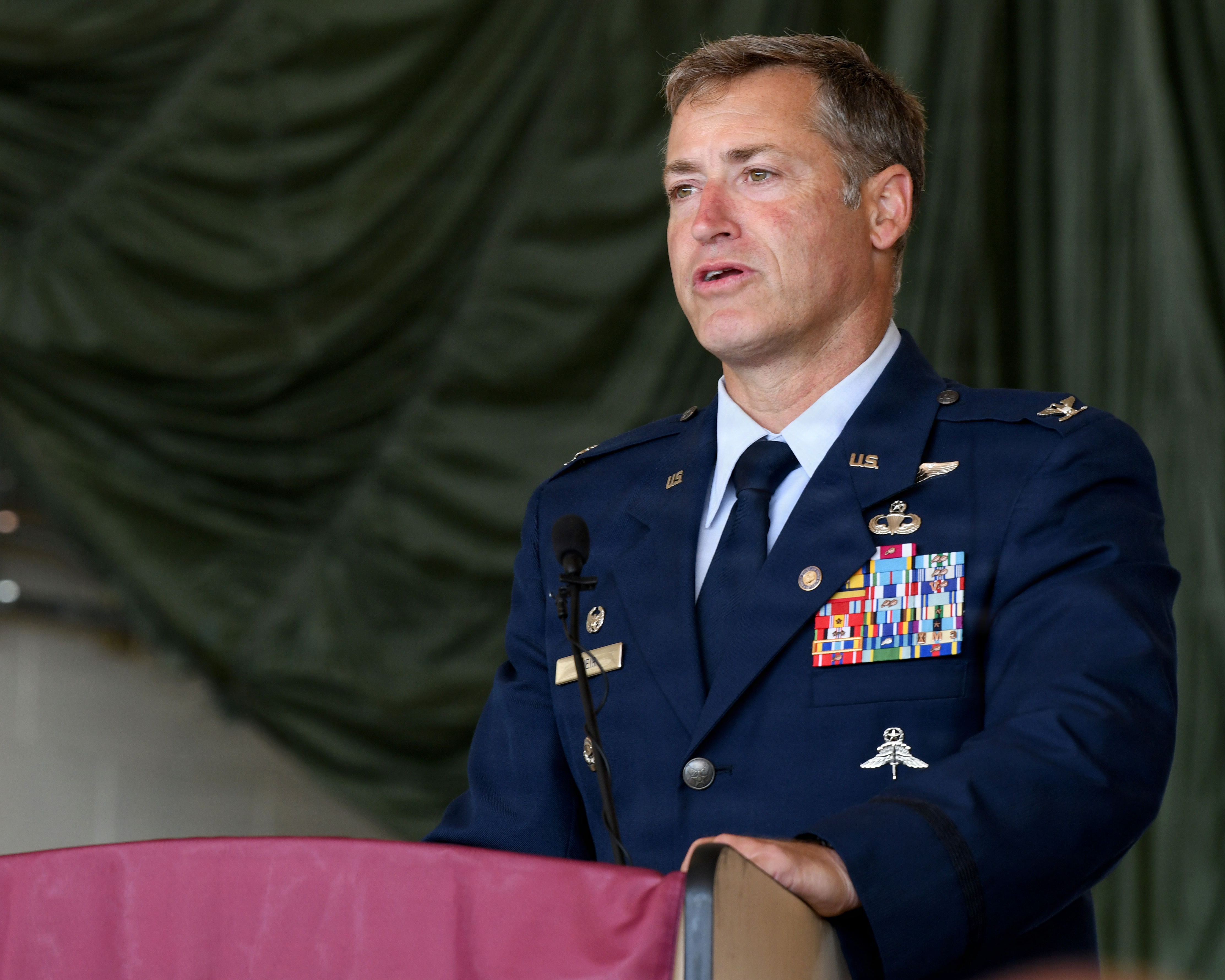
New York Air National Guard Col. Glyn B. Weir, assigned to the 106th Rescue Wing, speaks during his retirement ceremony at Francis S. Gabreski Air National Guard Base, Westhampton Beach, New York, June 6, 2026. Weir retired after 34 years of military service, including more than two decades with the 106th Rescue Wing. (U.S. Air National Guard photo by Tech. Sgt. Kevin Donaldson)