NY Army Guard officer Sean Flynn, a Delmar resident, plays key role in NATO Joint Force Command headquarters
Major General Sean Flynn, a veteran of wars in Iraq and Afghanistan serves as Deputy Chief of Staff for Operations at Allied Joint Force Command Brunssum
Brunnsum, Netherlands (02/26/2026) — Sean Flynn, a New York Army National Guard officer and Delmar resident, is now a two-star major general serving as the top U.S. officer in NATO's Allied Joint Force Command Brunssum.
Flynn is serving as the Deputy Chief of Staff for Operations at Allied Joint Force Command Brunssum. The command takes its name from its location in the Netherlands.
The command focuses on joint operations in central Europe, with a special focus on Poland and the Baltic countries, which are right next to Russia, Flynn explained.
The command is structured to control up to 250,000 troops from multiple countries, Flynn said. His job is to coordinate the operations of the headquarters and synchronize those forces, he explained.
He was promoted to major general in January.
Prior to this, Flynn was serving as the Deputy United States Military Representative to NATO's Military Committee in Brussels.
The U. S. Military Representative serves as the direct representative for the Chairman of the Joint Chiefs of Staff to NATO, Flynn said.
And for half his time in Brussels, Flynn served as the Acting Military Representative, from July - December 2023 and again from April - November 2025.
His wife and daughter are still at home in Delmar, Flynn said, but they visit him in Europe when they can.
Sean Flynn was still new to the New York Army National Guard on Sept.11, 2001, when two hijacked planes slammed into New York City's Twin Towers.
He responded to the aftermath of the attack-dealing with dust and death-- and then led a company in the streets of Baghdad and served as executive officer of a battalion in combat in Afghanistan.
Flynn had previously served as an Air Force public affairs officer in Alaska from 1994 to 1997. Then in 2000 -after a break in the inactive reserves--he became 1st Lt. Flynn in the "Fighting 69th", the 1st Battalion, 69th Infantry Regiment.
Eventually, he left his career in corporate communications and became a full-time Guardsman, serving as a battalion and brigade commander, and a division chief of staff in Kuwait.
His background as a National Guard officer has helped him quite a bit in the job he's had since Dec.1, Flynn said.
"There are so many parallels between our work in the National Guard and working with a 32-nation alliance," he said.
Guardsmen are used to working with different state Guard units, who all do things a little bit differently, Flynn explained.
Guard leaders get used to making all those different units mesh, as well as working with local police, fire departments, and local political leaders, he added.
"Just as the states and territories in the U.S. have their own interests, and priorities, and operational approaches, so do the nations here in NATO have their own interests and priorities," Flynn said.
Guardsmen are also very good at applying their civilian skills in their military life, Flynn said.
His civilian background as a consultant in New York City doing strategic communications for large multinational corporations, has also helped him work more effectively in the NATO environment, Flynn said.
Flynn comes from a family of New York Army National Guardsmen.
His father Col. Walter M. Flynn served, and his uncle, Major Gen. Lawrence P. Flynn, was adjutant general of New York.
A great, great, grandfather served in the Irish Legion in the Civil War, and that ancestor's brother, Capt. Edward K. Butler, served in the 69th New York Infantry at Bull Run in 1861, then died in action at the Battle of Cold Harbor in 1864.
Other Flynn ancestors and relatives served in the Fighting 69th during the Spanish-American War, World War I, and World War II, he said.
So, after serving in the Air Force--and writing a book about his experiences in Alaska-- it was logical for him to join New York's historic Irish regiment himself, Flynn said.
When the 69th Infantry deployed to Iraq in 2004/2005, Flynn was part of the battalion's fight to secure Route Irish, the road from the Baghdad Airport to the Green Zone.
Flynn wrote about that mission in his 2008 book, "The Fighting 69th, from Ground Zero to Baghdad."
In 2012, he deployed to Shindand, Afghanistan with the 108th Infantry, where the Soldiers conducted 577 security missions.
He went on to command the 69th, serve as chief of staff of the 42nd Infantry Division, and then commanded the 27th Infantry Brigade Combat Team.
In July of 2023, Flynn made the leap to general officer pinning on the one star of a brigadier general and deploying to Europe as the Deputy United States Military Representative to NATO's Military Committee in Brussels.
That was an amazing job, Flynn said.
"What an incredible opportunity it is to participate on the very leading edge of policy creation and implementation for the joint force," Flynn said. "This is not something that National Guard officers are commonly exposed to."
He's clearly had an unusual career for a National Guard officer, Flynn said.
Along with his commands, and division chief-of-staff role, he's also served at New York National Guard headquarters in key staff roles.
But like every other Guardsman, he started out just trying to balance his military life and civilian life, Flynn recalled.
"I think all of us, throughout our careers, are constantly trying to wrestle with how to make service work for us, with our jobs, and with our families," Flynn said.
"We make decisions, we make compromises, but we don't know where it is going to go."
"If you take each assignment seriously, and give it your level best, you may get the opportunity to serve at another echelon or another capacity that you never imaged," he said.
Media Attachments
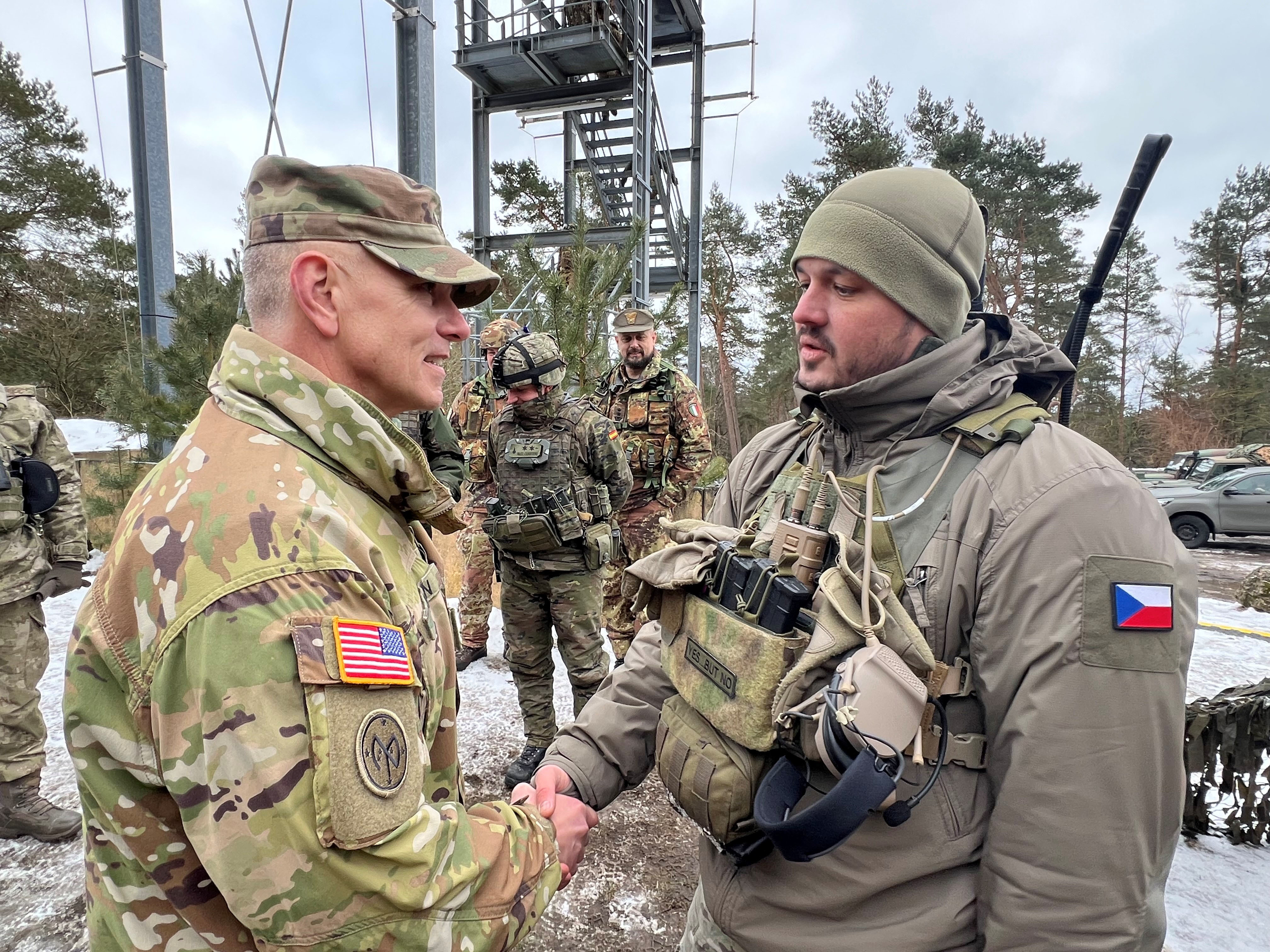
Army Major General Sean Flynn, left, originally a New York National Guard officer from Delmar, New York, greets a Czech Army Joint Terminal Attach Controller (JTAC) at the Bergen Training Area in Bergen, Germany on February 18, 2026, while visiting NATO Exercise Steadfast Dart 26. The exercise was the first full scale deployment of NATO’s Allied Reaction Force. Flynn, a veteran of the wars in Iraq and Afghanistan and the New York National Guard’s response to the Sept. 11, 2001, currently serves as Deputy Chief of Staff for Operations at Allied Joint Force Command Brunssum. ( Courtesy photo by Air Force Lt. Col. Scott R. Hendrix)

New York National Guard
Eric Durr, 518-786-4581Share this Story


Recent News
- New York Army Guard Chief Warrant Officer 5 Sean Fredericks, an East Greenbush resident, retires after nearly 30 years of service
- Glenmont resident David Prescott is promoted to Chief Warrant Officer in the New York Naval Militia
- New York Army National Guard salutes unknown Revolutionary War Soldiers killed in 1776 Battle of Valcour Island
- Halfmoon resident Eric Underhill promoted to one-star general rank during October 3 ceremony
- Ballston Spa resident Michael Golden, promoted to Lieutenant Colonel in the New York Naval Militia
- New York Army Guard Chief Warrant Officer 4 Victoria Whitley, a New Windsor resident who grew up in Washington, D.C. retires after 35 years of service
- New York National Guard marks birthday of President Chester Arthur with wreath laying ceremony in Albany Rural Cemetery
- NY Army National Guard salutes President Chester Arthur this morning, Monday, October 5 during ceremony at Albany Rural Cemetery
- New York Army Guard Major General Michel Natali, a Watertown native, retires after almost 40 years of service
- New York Army Guard Major General Michel Natali, a Watertown native, retires after almost 40 years of service