NY National Guard Honor Guard welcomes remains of World War II POW home to Capital Region on May 1
Lt. Joseph L. Burke grew up in Troy and died in Taiwan in 1945. His remains were unidentified until 2025.
Latham, New York (04/28/2026) — The New York Army National Guard will welcome home the remains of a Troy Airman who was killed during World War II on Friday, May 1, at Albany International Airport.
An honor guard will conduct a dignified transfer of the remains of United States Army Air Corps 2nd Lt. Joseph L. Burke. Burke died while a Prisoner of War of the Japanese on January 9, 1945.
There will be two media events connected with this return.
Members of the press are invited to speak with John Burke, a nephew of 2nd Lt. Burke and the family spokesman, on April 30 at the New York State Military Museum.
Members of the press are also invited to cover the dignified transfer of remains on May 1 at Albany International Airport.
APRIL 30 MEDIA EVENT
WHO: John Burke, and Bill Comisky, nephews of 2nd Lt. Burke.
WHAT: A press conference for area reporters.
WHEN: Thursday, April 30, 1 p.m.
WHERE: New York State Military Museum, 66 Lake Avenue, Saratoga Springs.
Contact Eric Durr at 518-429-5186 for information.
MAY 1 DIGNIFIED TRANSFER
WHO: Family members of 2nd Lt. Joseph L. Burke, members of the New York Army National Guard Honor Guard, and representatives of the Bryce Funeral Home in Troy.
WHAT: The dignified transfer of a casket containing the remains of 2nd Lt. Joseph Burke on the runway at Albany International Airport conducted by a New York Army National Guard Honor Guard.
The dignified transfer is not a ceremony, but it is a solemn and respectful movement of a service member's remains from one mode of transportation to another.
Burke was inadvertently killed by American forces while being transported from the Philippines to Japan with over 1,600 other American Prisoners of War in January 1945. His remains were not identified until 2025. DNA matching with family members enabled the identification.
WHEN: 3:30 p.m., May 1, 2026. Flight carrying the remains is due to arrive at 4:35 p.m.
Members of the press must contact Albany International Airport spokesman Matthew Hunter at 518-225-0641 for access to the runway area.
WHERE: Albany International Airport Fire Department , 10 Jetway Drive, Latham
Coverage Opportunities:
Video and still imagery of the event.
BACKGROUND:
2nd Lt. Joseph L. Burke
Joseph Leroy Burke, known as "Roy" to his family, was born in February 1914 and grew up in Troy. He was the son of Wiliam J. Burke and Kathryn Agnes (Dorr) Burke. His father died in 1963, while his mother passed away in 1966.
"Roy" Burke attended Catholic Central High School and graduated in 1932. In the fall of 1938 he enrolled in the second class at Siena College iand attended school through the spring of 1940.
During this time, he learned to fly at Albany Airport as part of the federal Civilian Pilot Training Program.
Created in 1939, the program used civilian instructors to train students at colleges and universities to be pilots. The goal was to develop pilots for the Army and Navy, as well as for civilian air services. Students paid a fee of $35 to $50 to enroll in the program.
In the fall of 1940, Burke was accepted as a cadet pilot in the Army Air Corps and attended the Chicago School of Aeronautics before moving onto the U.S. Army Advanced Flying School at Maxwell Field, Alabama. He graduated from the course in April 1941 as a "pursuit pilot"-the name for a fighter pilot at the time-and was commissioned as a second lieutenant.
He learned to fly the P-40E Warhawk, the Air Corps frontline fighter at the time.
"Roy" Burke had two older brothers. William J. "Bill" Burke, who was born in 1910 and Francis Clayton "Clay" Burke who was born in 1912.A sister, Mary Elizabeth :"Betty" Comiskey was born in 1921.
"Bill" Burke served in the New York National Guard, served in France and was awarded the Purple Heart for wounds received in combat. After the war he worked for the Federal Aviation Administration at Albany County Airport and died in 1986.
"Clay" Burke served in the Navy in the 1930s and then enlisted in the Army in October of 1940. He originally trained to be a tanker, but the Army moved him to a boat detachment because of his naval service, and he took part in the invasion of Normandy in 1944. He died in 1993.
"Betty" graduated from what was then the New York State College for Teachers in 1942. She taught briefly and spent most of her life as a homemaker. She died in 1983.
History and identification timeline.
As a new Army pilot Burke was deployed to the Philippines, which was then still a territory of the United States. He was assigned to the 3rd Pursuit Squadron of the 24th Pursuit Group, which was organized in October 1941 at Iba Field on the island of Luzon.
This was part of an American military buildup that was supposed to deter a Japanese attack as tensions rose between the two nations.
The day the Japanese attacked Pearl Harbor, which was Dec. 8 in the Philippines, Burke's squadron took off twice to deal with possible air attacks. The Japanese attacked when the 3rd Pursuit Squadron was on the ground and the aircraft were destroyed.
Without planes, most of the Soldiers assigned to the unit were sent to the Bataan Peninsula. They fought as infantrymen until American forces there were forced to surrender in April 1941 when they ran out of food.
Burke, however, was assigned to the Island of Corregidor, where he was attached to the 60th Coast Artillery Regiment. Corregidor served as the headquarters for the U.S. Army forces in the Philippines. The guns on the island also denied the Japanese access to Manila Bay and the port at Manila.
On May 5, 1942, the Japanese bombarded and invaded the island. The 11,000 Americans and Filipinos who defended the island surrendered on May 6.
Burke and the other American prisoners of war were held at Cabanatuan POW Camp on the island of Luzon where conditions were very poor.
In December of 1944, as American forces were closing in on Luzon, the Japanese began shipping U.S. prisoners to Japan. The prisoners were to be both slave labor and bargaining chips to use in negotiating a settlement with the United States.
Burke was on one of these ships, the Oryoku Maru, along with 1,618 other POWS. Unfortunately, because the Japanese did not mark these ships as POW transports, many were sunk by American planes and submarines.
In this case, the Oryoku Maru was sunk by U.S. Navy planes in Subic Bay. The prisoners who survived, which included Burke, were then loaded onto a ship called the Enoura Maru. That ship made it to Taiwan-then a Japanese colony-before it too was sunk by U.S. planes on January 9, 1945.
The Japanese military listed Joseph Burke as one of 406 prisoners who were killed in that attack.
In 1946, members of the American Graves Registration Service disinterred the remains of those prisoners from a mass grave.
Because the remains of 432 POWS who embarked on the Enoura Maru could not be identified, they were transported to the National Memorial Cemetery of the Pacific in Honolulu, Hawaii, and interred as unknowns.
Burke was memorialized on the Wall of the Missing at the Manila American Cemetery on Luzon in the Philippines.
In 2015, the Defense POW/MIA Accounting Agency asked families associated with the missing service members from World War II in the Pacific for DNA samples.
In 2022, the remains of the Enoura Maru and Oryko Maru dead were disinterred and then tested. The remains of 2nd Lt. Joseph Burke were identified and the identification announced on May 12, 2025.
Burke Family Plans to memorialize 2nd Lt. Joseph Burke
May 7: 11:30 a.m.: A Mass of Christian Burial at Siena University Chapel. Family and invited guests only.
May 7: 12:30 p.m. Funeral procession to Gerald B. H. Solomon -Saratoga National Cemetery, Schuylerville, New York.
May 7: 2:00 p.m. Casket moved to horse-drawn caisson by the New York National Guard Honor Guard. Committal shelter service, military honors, funeral flyover Committal Shelter #2 with interment to follow in section #9.
New York Army National Guard Honor Guard.
The New York Army National Guard Honor Guard provides military funeral honors to all those who have served in the Army. Sixty-nine Army National Guard Soldiers are trained to conduct these military funerals.
Federal Public Law 106-65 requires that at least two service members attend a funeral, ensures that taps are played - usually with an "electronic bugle" - and that a flag is provided to the family of the former service member.
Retired military members and those who die on active duty are eligible for more elaborate services, including up to nine honor guard members and a rifle salute.
In 2025, the New York Army National Guard provided military funeral honors at services for 5,051 Army veterans.
Media Attachments
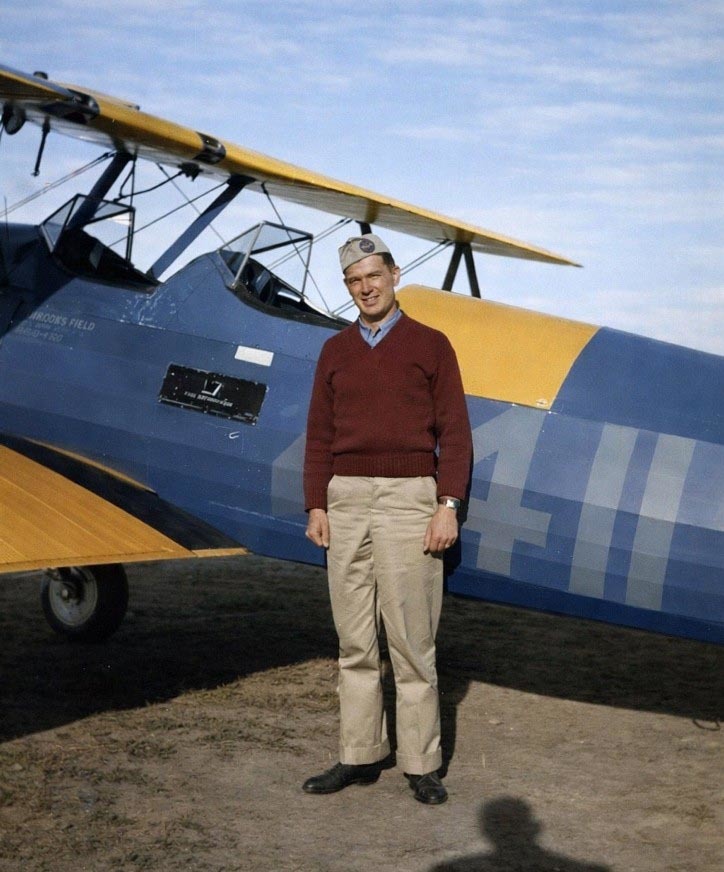
U.S. Army Air Corps flying cadet Joseph L. Burke poses in front of a Sterman PT-17 basic flight trainer during his flight training. (Courtesy John Burke)
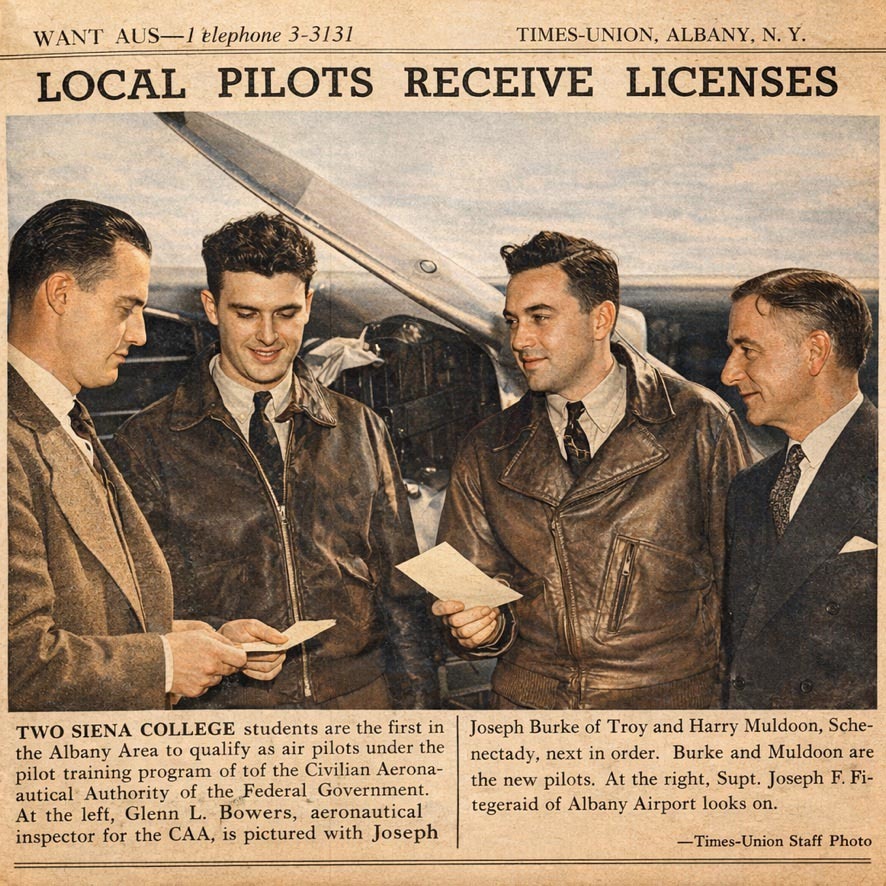
A clipping from the Albany Times Union features Army Air Corps 2nd Lt. Joseph L. Burke when he was a civilian student pilot attending Siena College and learning to fly through the government-supported Civlian Pilot Training Program. Burke was killed in January 1945 while a prisoner of the Japanese during World War II. ( Courtesy John Burke)
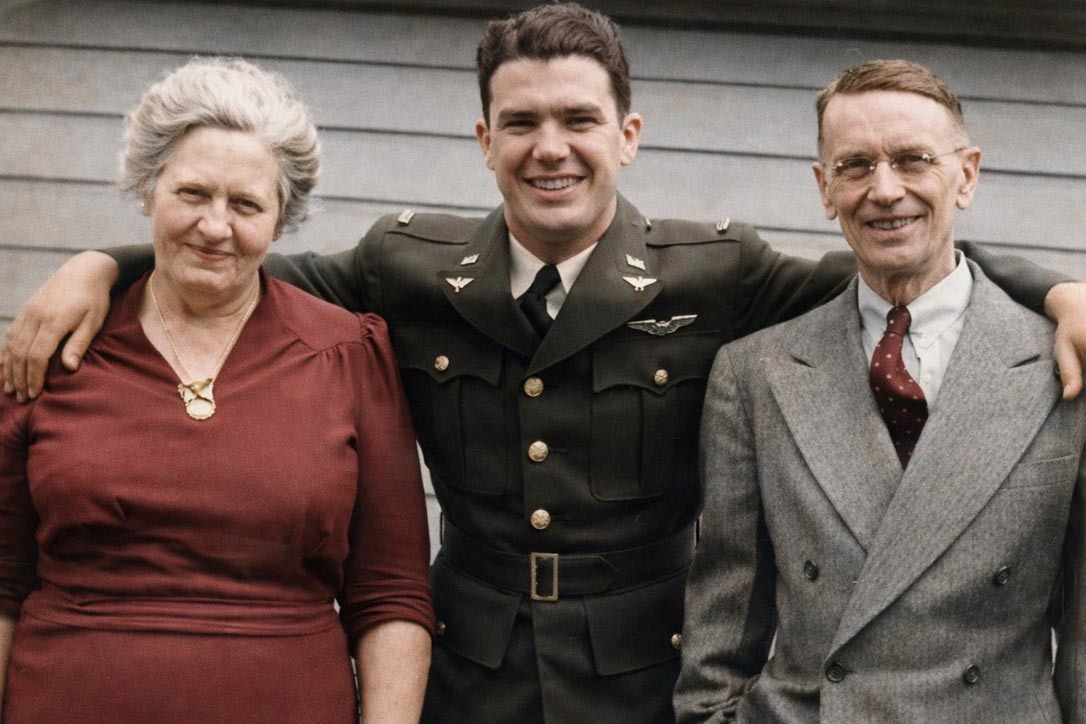
Army Air Corps 2nd Lt. Joseph Leroy "Roy" Burke and his parents Kathryn and William, prior to his deployment to the Philippines in 1941. Joseph Burke, who grew up in Troy, New York, died as a prisoner of the Japanese in January 1945. His parents passed away in 1966 and 1963, respectively. (Courtesy John Burke)

New York National Guard
Mr. Eric Durr at 518-429-5186 for National Guard questions and Matt Hunter at 518-225-0641 for the Albany International AirportShare this Story


Recent News
- NY Army National Guard salutes President Chester Arthur this morning, Monday, October 5 during ceremony at Albany Rural Cemetery
- New York Army Guard Major General Michel Natali, a Watertown native, retires after almost 40 years of service
- New York Army Guard Major General Michel Natali, a Watertown native, retires after almost 40 years of service
- New York Army Guard Major General Michel Natali, a Mechanicville resident, retires after almost 40 years of service
- NY Army National Guard salutes President Chester Arthur during Monday, October 5 ceremony at Albany Rural Cemetery
- Major General Michel Natali, a Mechanicville resident, retires from New York Army National Guard during ceremony this afternoon, Friday, October 2
- Albany County Executive Dan McCoy retires from New York Army National Guard after 37 years of service
- Major General Michel Natali, a Mechanicville resident, retires from New York Army National Guard after 39 years during October 2 ceremony
- Naval Militia officers promotions held at New York State Military Museum in Saratoga Springs on Thursday, October 1
- Sgt. 1st Class Jacob Pratt, NY Army Guard crew chief badly injured in 2024 helicopter crash takes "final flight' with friends