NYS Military Museum cuts ribbon on exhibit highlighting New Yorkers role in the Global War on Terror on Thursday, Nov. 5
Permanent exhibit highlights the role of the New York Army and Air Guard as well as other services in Iraq and Afghanistan
SARATOGA SPRINGS, New York (10/30/2026) — Major General Ray Shields, the adjutant general of New York, will officially open the newest exhibit at the New York State Military Museum in Saratoga Springs on Thursday, Nov. 5.
The exhibit focuses on New Yorkers and the Global War on Terror which lasted from September 2001 to August 2021.
Members of the press are invited to cover the short ceremony and explore the exhibit.
WHO: Major General Ray Shields, the adjutant general of New York; Richard Goldenberg, the director of the New York State Military Museum; Retired Major General Joseph Taluto, the commander of the 42nd Infantry Division in Iraq in 2005 and a trustee of the Friends of the New York State Military Museum; veterans of the wars in Iraq and Afghanistan.
WHAT: Ribbon cutting ceremony officially opening the New York State Museum's permanent exhibit on the Global War on Terror, known in military terms as GWOT. The exhibit traces the history of New York's involvement from the attacks of Sept. 11, 2001, to the final withdrawal from Afghanistan in August 2021. The exhibit's creation was underwritten by the Friends of the New York State Military Museum.
WHEN: 1 p.m., Thursday, November 5.
WHERE: New York State Military Museum and Veterans Research Center, 61 Lake Ave, Saratoga Springs.
Coverage Opportunities:
Reporters will have the opportunity to speak with GWOT veterans, members of the Friends of the New York State Military Museum and museum staff, and collect imagery of the ceremony and the exhibit.
BACKGROUND:
The Global War on Terror Exhibit
The display --"New Millennium, New Challenge: The Global War on Terror, 2001-2021" -- is a permanent exhibit which chronicles New York's role in the 20 years of the Global War on Terror, the long struggle to defeat radical terrorists following the deadly September 11, 2001, terrorist attacks on the United States.
On Sept. 11, 2001, New York Army National Guard Soldiers responded to the World Trade Center site in southern Manhattan to assist the New York Police Department in the aftermath of the collapse of the Twin Towers.
Almost 20 years later, in August 2021, Airmen of the New York Air National Guard's 105th Airlift Wing evacuated American Soldiers, civilians and Afghan allies, from Kabul, along with the remains of the last 13 Americans killed in Afghanistan.
In between thousands of New Yorkers served in Afghanistan and Iraq as part of the worldwide struggle with the Army, Marine Corps, Air Force, Navy and Coast Guard.
The exhibit includes uniforms, weapons and other artifacts of the service of New Yorkers from Afghanistan and Iraq. The displays also reflect the historic deployments of New York Army and Air National Guardsmen.
The Friends of the New York State Military Museum raised $100,000 to cover the design, construction and installation of this permanent exhibit in the Saratoga Springs museum.
The not-for-profit is also exploring the creation of a traveling exhibit which can bring the story of that war to New Yorkers across the state during 2027.
The New York State Military Museum and Veterans Research Center
Located at 61 Lake Avenue in Saratoga Springs, N.Y, the New York State Military Museum is administered by the New York State Division of Military and Naval Affairs. Its collection focuses on New York's military history from the French and Indian Wars to the present day.
The mission of the museum is to preserve, interpret and disseminate the story, history and records of New York State's military forces and veterans.
Begun in 1863 during the Civil War, the collection did not have a permanent home until Governor George Pataki decided in 2001 that the historic armory in Saratoga Springs, NY would house the collection. The building, designed by Isaac Perry and constructed in 1889, is an example of armory architecture that was popular in upstate New York in the late 1800's.
Media Attachments
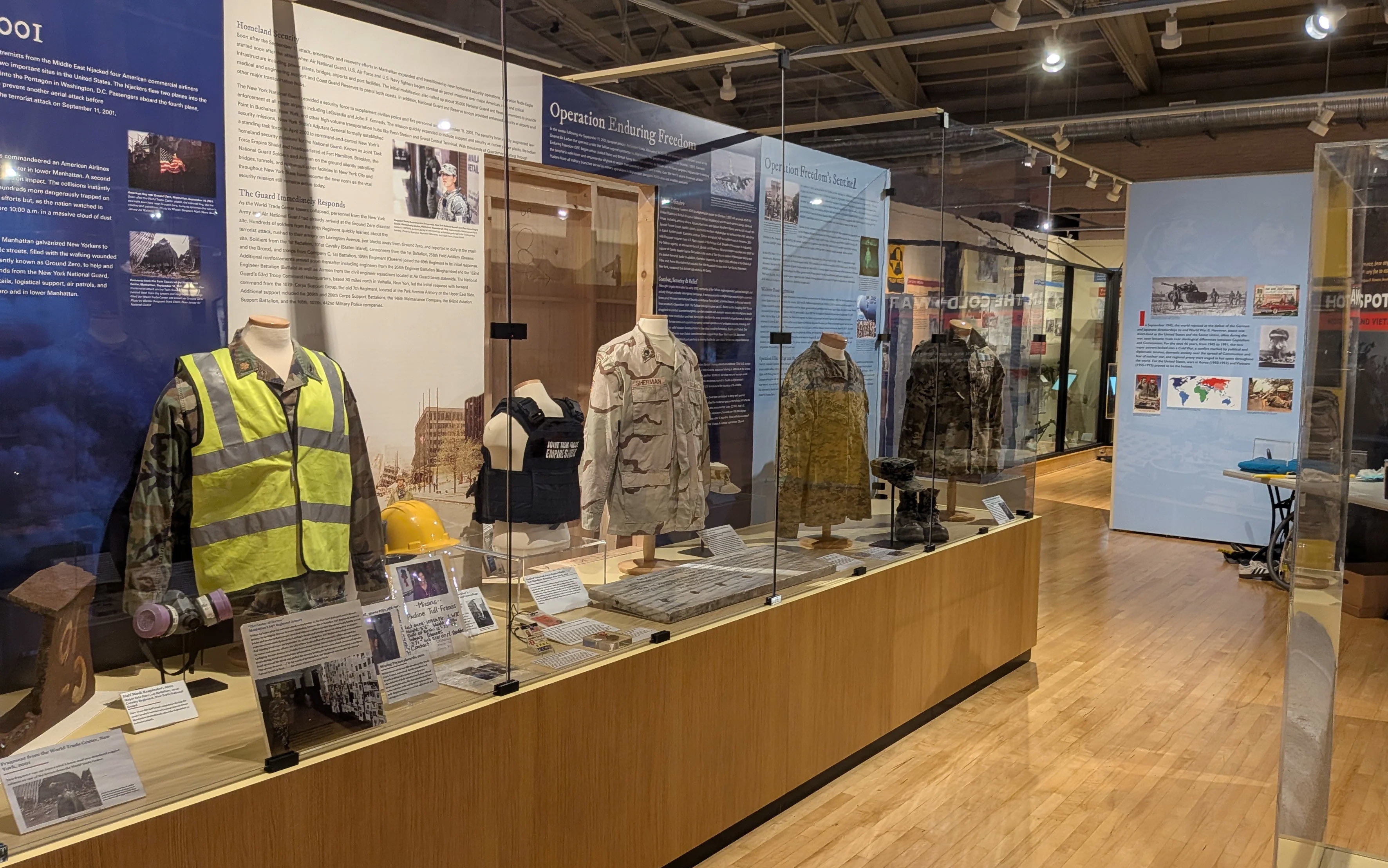
The New York State Military Museum is telling the story of the Global War on Terror-- or GWOT-- with a permanent exhibit featuring uniforms, artifacts, weapons and photographs explaining New Yorkers role in the 20-year conflict. The museum is located in Saratoga Springs, New York.