Two Airman assigned to NY Air Guard's 105th Airlift Wing brave cold during Minnesota training course
Tech Sgt. Kevin Meehan, from Newburgh, and Tech Sgt. Alexander Santana from Jamaica, Queens graduate from Cold Weather Operations Course
Stewart Air National Guard Base, Newburgh, N.Y. (03/25/2026) — Two Airmen assigned to the 105th Airlift Wing's Base Defense Squadron recently completed the Air National Guard's 16-day Cold Weather Operations Course, or CWOC, a program designed to prepare Airmen for operations in subzero environments.
Tech Sgt. Kevin Meehan, a Newburgh resident, and Tech Sgt. Alexander Santana, from Jamaica Queens, attended the course in January at the Minnesota National Guard's Camp Ripley Training Center near Little Falls.
Temperatures in the area often drop below zero and wind chills amplify the cold.
Participants learn survival skills, equipment management and mission-essential tasks in these extreme environments.
Meehan said he was looking for a demanding experience to break out of his comfort zone, and this training delivered exactly that.
Meehan, originally from Washingtonville, New York, brings a varied military background to his role.
He enlisted in the U.S. Marine Corps out of high school in 2009, serving in infantry with anti-armor and mortar specialties until 2014. After a break in service, he rejoined the military in 2018, this time in the Air National Guard.
He served part time in a drill status until 2021 then transitioned to full-time Active Guard Reserve status, all with the 105th Base Defense Squadron.
Meehan said he got interested in the cold weather course after he completed a challenging but shorter Special Reaction Team course in 2023. Still wanting to test his limits, he sought something more demanding.
Maj. Brian Ibbs the 105th Base Defense Squadron commander, had experienced the course and recommended the program as an ideal next step, Meehan said.
Santana said he was looking for a challenge as well, while also looking to bring these skills back to his squadron.
"I never thought I'd be out there in negative 35, but now I know I can survive it," Santana said.
Santana is originally from Ozone Park, Queens, New York.
Before joining the Air National Guard, he served in the Army as a combat medic. He said he was motivated to attend the CWOC by the opportunity to boost unit lethality, especially since only about 10 Airmen in the 105th Base Defense Group have cold weather qualifications. The course represented a chance to operate in colder regions, so Santana signed up and prepared for the challenge, he added.
Meehan said he went in expecting plenty of hiking, camping and cold exposure, but the sheer intensity of the subzero conditions hit far harder than anticipated.
"You don't understand how cold it is until you're there," said Meehan. "It might say it's only negative five but with wind chill it's just a different kind of cold, and there's no respite from it."
The curriculum focused on functional warmth rather than comfort, preventing frostbite by managing layers, avoiding sweat during exertion and trusting in issued gear. One of the biggest surprises for Meehan was the challenge of staying hydrated in such extreme conditions.
"Everyone in the military knows hydrate, hydrate, hydrate. One thing you don't think about is it's so cold your water freezes," he said.
Santana said he expected a pure survival course, learning skills for scenarios like a downed aircraft or getting stuck in a remote location with no support.
While it covered those basics, such as starting fires with minimal materials, building thermal shelters from sticks, twigs, tarps or ponchos and setting up arctic tents, he said the reality was far more demanding.
Teams of 9 to 12 Airmen took turns pulling sleds weighing 350 to 400 pounds, loaded with tents, stoves, food, fuel, water and tools, while also carrying packs weighing over 40 pounds.
Santana's team started shorthanded and more members dropped out early, forcing the remaining five to haul multiple sleds in temperatures below negative 30 degrees on one of the coldest nights of the course.
"That second day in the field was the most physically demanding. We rucked the most with the least people, and it was brutally cold," Santana said. "We finished an hour and a half after everyone else, but we made it."
An added surprise was the wildlife, said Santana. Timberwolves were tracking his group, leaving massive paw prints in the snow.
"It was cool but kind of scary. There were no weapons, just us out there," Santana said.
Overall, the training tied directly to security forces missions that both Meehan and Santana could encounter. Guarding airfields in cold environments demands readiness for frozen water supplies, brittle equipment, contact frostbite from touching bare metal weapons without gloves and prolonged operations with no quick access to indoor warmth or relief.
Being exposed to these realities built critical awareness, helping to prevent mistakes in future missions, they said.
To future attendees, Meehan offered straightforward advice:
"Don't quit. Everyone moves as a team. Put one foot in front of the other. It will end eventually." Meehan said.
Santana said that teamwork is important and fitness matters.
He advised training on a stair climber with a heavy rucksack, hiking to build leg strength, training in the cold ahead of time, practicing knots for tents and shelters, and keeping morale high since the cold tends to make everyone more irritable.
Santana added that his biggest takeaway was packing accordingly. A heavier "ruck" with the right gear boosts your survivability more than going light and risking it, he said.
"I finished proud," said Meehan. "The training pushed me hard, but I came out ready to deal with more extreme environments."
The 105th Airlift Wing, based at Stewart Air National Guard Base in Newburgh flies the C-17 Globemaster III strategic airlifter. The wing also deploys trained Airmen overseas as required and provides Airmen for state active duty missions here at home.
Media Attachments
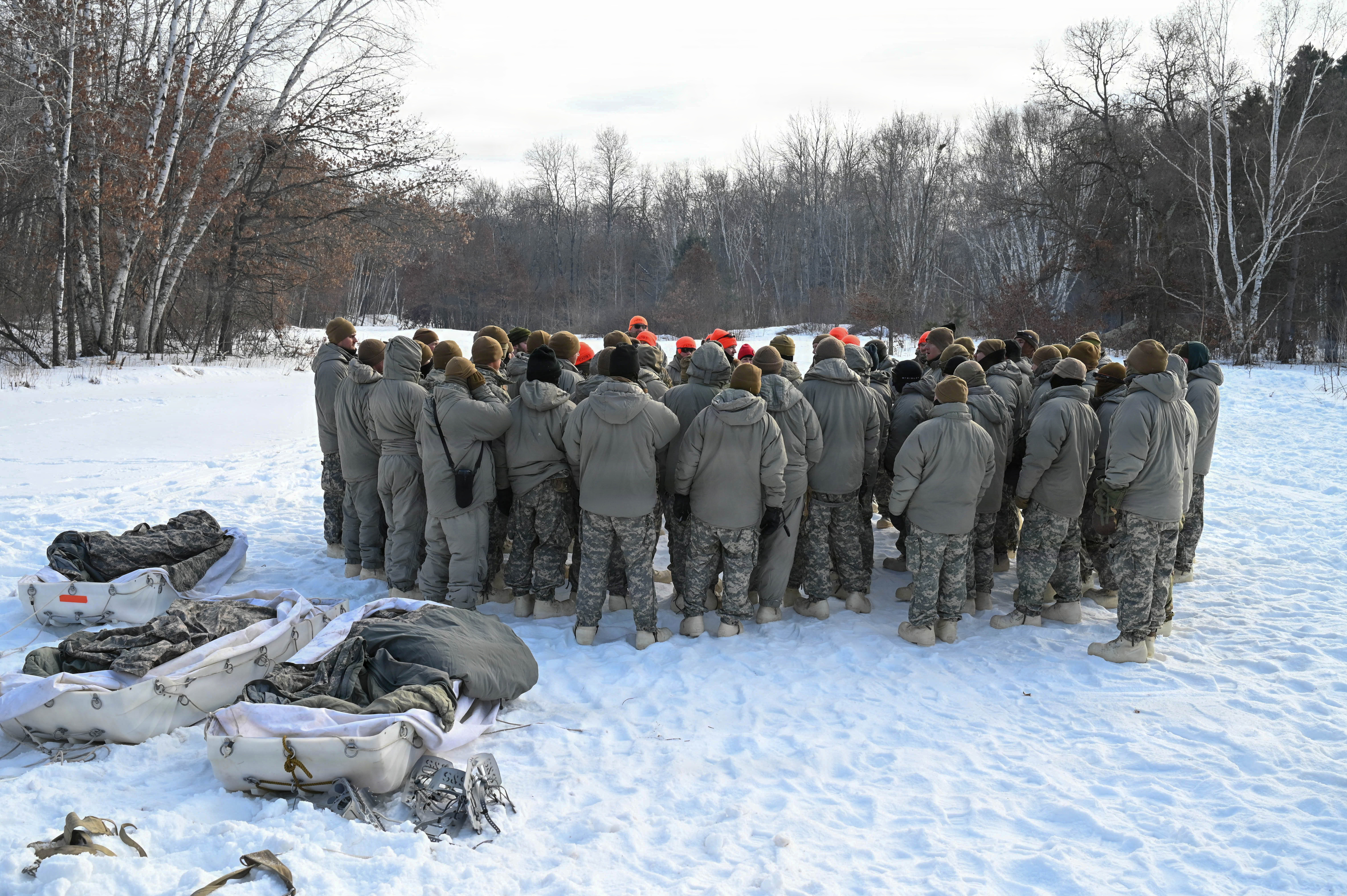
Air National Guard Cold Weather Operations Course cadre brief participants as part of the Air National Guard's CWOC at Camp Ripley Training Center, Minn. January 30, 2026. The two-week course combined classroom instruction, outdoor skill development and a field training event that required students to operate and sleep outdoors, incorporate land navigation, life saving skills, and a cold water immersion event. (U.S. Air National Guard photo courtesy by Senior Airman Addie Peterson)