New York Army National Guard salutes unknown Revolutionary War Soldiers killed in 1776 Battle of Valcour Island
Latham, NY (10/13/2026) — SCHUYLERVILLE, New York- American Soldiers killed in a naval battle on Lake Champlain 250 years ago were honored by the New York Army National Guard on Tuesday, Oct. 13.
A New York Army National Guard Honor Guard provided military funeral honors for the remains of crewmen from the gunboat Philadelphia during a ceremony held at Gerald B.H. Solomon Saratoga National Cemetery in Schuylerville.
The boat, manned by 44 Soldiers who were mostly members of the New Hampshire militia, was sunk by a British ship during the October 11,1776, Battle of Valcour Island.
The battle-during which 11 American vessels were sunk-was a tactical defeat for the Continental Army. But the British delayed their attack on Fort Ticonderoga until 1777 because of the fight.
Eleven New York Army National Guard Soldiers, comprising a three Soldier firing party, a bugler, an officer in charge, and a pallbearer detail, provided full honors for the remains of crewmen found within the hold of the Philadelphia.
A team of Revolutionary War reenactors saluted the unknowns with musket fire, this was followed by the Army Guard firing party, which fired seven rounds each. Staff Sgt. Alexandra Johnson then played taps.
Major General Ray Shields, the adjutant general of New York, presented the folded flag which had laid on the casket to Lisa O'Brian, the New York state regent for the Daughters of the American Revolution.
O'Brien was standing in the for families of the five crewmen of the Philadelphia who historical researchers from the Smithsonian Institute have determined likely died during the battle.
Shields said he was very proud, "and actually a little bit emotional" to participate I the ceremony.
While the equipment Soldiers carry has changed between 1776 and 2026, being a Soldier hasn't changed too much, Shields said.
"The same hardships [the Philadelphia crew] went through in October on the lake are the same things U.S. Army Soldiers experience today," he said.
Staff Sgt. Ryan Gosse, the honor guard non-commissioned officer in charge, said performing a military funeral to honor Soldiers from the past is a unique honor.
"I've done a couple of Revolutionary War services here and, I think they're always special, because we are honoring veterans from even before the nation was established," he said.
"I think this one matters a little bit more because they are unknown," Gosse added.
"It just goes to show you that the Army and the National Guard will always be there, no matter who you are, if you have a name or if you don't. As long as you've served, and you did something for this country we will be there for you," Gosse said.
The remains of unknown members of the Philadelphia crew -- some bones, a skull fragment and six teeth-were found inside the hull when the boat was raised from Lake Champlain in 1935.
Over the years the bones and skull fragments vanished. The six teeth survived and were interred at the cemetery.
A standard Army-issue headstone commemorating the battle and the Soldiers who fought in it, provided by the Army, was placed at the cemetery's Memorial Path before the day was done.
The inscription reads: "UNKNOWN SOLDIERS, CONTINENTAL ARMY, GUNBOAT PHILADELPHIA,BATTLE OF VALCOUR ISLAND,LAKE CHAMPLAIN NY OCT 11 1776"
The Philadelphia has been displayed in the National Museum of American History since the museum opened in 1964. It is being conserved and preserved by the Smithsonian Institution and a team from Texas A&M University.
Jennifer Jones, the Smithsonian Institution curator responsible for the Gunboat Philadelphia Project, said preserving the boat, is important because of the part it played during a key moment in American history.
"It is a witness. It is a witness to that battle, to the Revolution. It has survived 250 years, and our project is to make sure it survives for another 250," Jones said.
Being there to honor the crew of the Philadelphia was extremely important, Jones said.
The fleet that fought on Lake Champlain in 1776 was built very quickly and crewed by men who were not sailors, but who fought hard, Jones said.
Army experts determined that scientific testing of the teeth would be unlikely to determine who those remains belong to, or to identify direct descendants.
For this reason, the interment was conducted as a group interment representing all casualties from the gunboat, according to Army Human Resources Command.
Philadelphia was one of 15 vessels built to stop a British fleet heading south on Lake Champlain. General Benedict Arnold, who had been a merchant sea captain, commanded the fleet crewed by Soldiers.
In the fall of 1776 the American effort to invade and capture Canada-what is now Quebec-had failed and the American forces had retreated back from Montreal to Fort Ticonderoga.
The British, under General Guy Carleton were building a fleet of boats, gunboats and even a 22-gun ship- -to advance down Lake Champlain to take the fort, which the Benedict Arnold and Ethan Allan had captured in 1775.
General Philip Schuyler, the Continental Army commander in northern New York launched a campaign to build an American fleet in what is now Whitehall New York. The Americans constructed 16 vessels - mostly sailed and rowed boats with one to three cannons each-and launched them onto Lake Champlain.
Arnold took his fleet north and deployed them in the straight between Valcour Island and the New York shore of Lake Champlain just south of what is now Plattsburgh.
He expected the British to pass the island without seeing his fleet. They would then have to turn and head into the American boats which would be anchored and firing at them.
The British fleet headed south on October 9, and the situation developed as Arnold had predicted. The British had to turn back north and the battle started at 12:30 p.m. and lasted until dark.
The British had managed to bring their 22-gun ship into action and that vessel caused serious damage to Arnolds boats and ships.
The Philadelphia was hit by a 24-pound ball and sank at 6:30 p.m. The surviving crew evacuated to the gunboat Washington before Philadelphia sank.
When darkness fell the British landed Soldiers and Indian allies on the shore and island to prevent the American crews from beaching and escaping.
Arnold managed to slip his 14 remaining vessels, many of which were in bad shape, past the British in the dark.
For the next two days the British chased the American boats down the lake, until all but four were sunk or grounded and burned.
The Americans lost the battle. But they had hurt the British enough that Carlton decided to delay the attack. When British forces attacked south again in 1777, they were defeated at Saratoga.
Philadelphia was one of eight gundalows or gondolas -- called that because they could be rowed or sailed-built by the Americans.
Construction started in July and the boat was finished in August. It was 53 feet long, 15 feet wide and 5 feet deep. It mounted three canons, one 12- pounder in the bow and two nine- pounders on either side. Cannon were rated based on the weight of the cannon ball they fired.
As Philadelphia was sinking, the surviving crew boarded the Washington-- a row galley -- and escaped south on that vessel.
Washington, however, had also been hit by enemy fire and was almost sinking. It was captured by the British, repaired, and became part of the British fleet.
But 17 of the Soldiers who crewed Philadelphia escaped in a boat before the surrender. The British later released the Soldiers captured on the Washington-including crew from the Philadelphia-in exchange for a promise not to serve against them again.
Smithsonian Institution researchers have determined that 39 Soldiers who served on the Philadelphia survived the Battle of Valcour Island.
The five men who may have died on board or during the escape from the British fleet are:
o Ebenezar Bailey
o Ezekiah Budthomas
o John Leach
o Benjamin Walker
o Daniel Whitworth
In 1935 Lorenzo Hagglund, a veteran of World War I and a history buff, discovered Philadelphia's remains sitting upright on the lake bottom. Along with the three guns hundreds of other items were recovered from the vessel.
These relics included shot, cooking utensils, tools, buttons, buckles and human bones and at least six teeth. The Smithsonian Institution held three teeth found in the Philadelphia.
Three other teeth belonged to a collection of material that Hagglund gave to the funder of his expedition, brewer J. Rupert Schalk.
When Schalk died in 1962, his collection ultimately went to Rear Admiral John E. Kirkpatrick, who was deeply interested in naval history. His collections were donated to the Oklahoma Science and Arts Foundation in Oklahoma City, now known as Science Museum Oklahoma, a Smithsonian Affiliate.
The Science Museum decided to turn their remains from the Philadelphi over to the Army so they could be interred with the teeth held by the Smithsonian Institution.
The Philadelphia was exhibited on a barge on Lake Champlain at locations along the lake, before becoming a roadside tourist attraction in Exeter, New York.'
Haggalund decided to bequeath the boat to the Smithsonian after his death. He died in 1960, and in 1961 his widow turned the Philadelphia and the artifacts that Haggalund still held over to the Smithsonian Institution.
Media Attachments
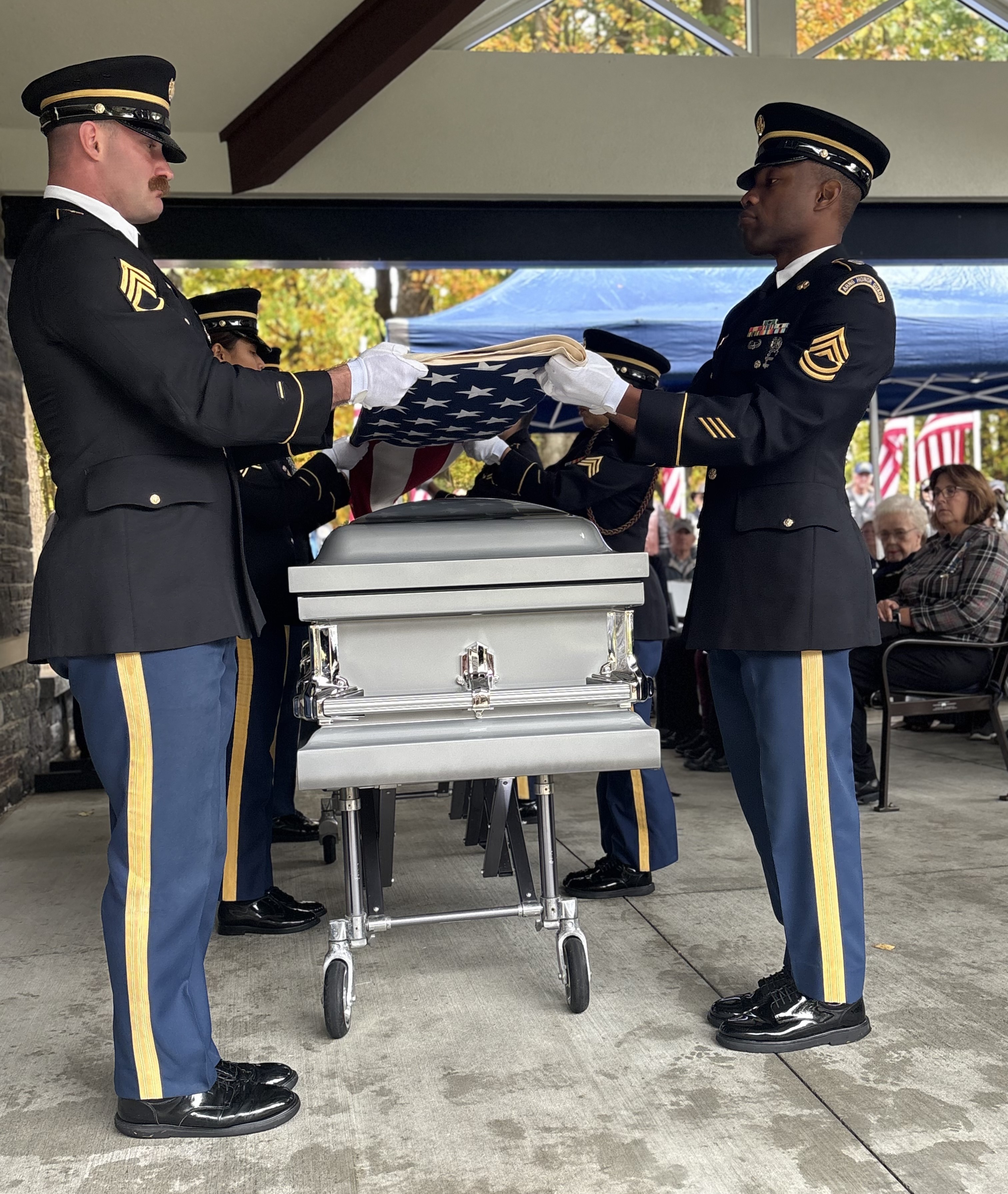
Members of the New York Army National Guard Honor Guard fold an American flag placed on the casket containing remains of Revolutionary War Soldier, during a military funeral for those unknown Soldiers who died at the 1776 Battle of Valcour island during an Oct. 13, 2026 ceremony at Gerald BH Solomon Saratoga National Cemetery in Schuylerville, New York. The Soldiers died during the Battle of Valcour Island on October 11, 1776, which was fought against a British fleet on the waters of Lake Champlain. (U.S. Army National Guard photo by Lt. Col. Jean Marie Kratzer)
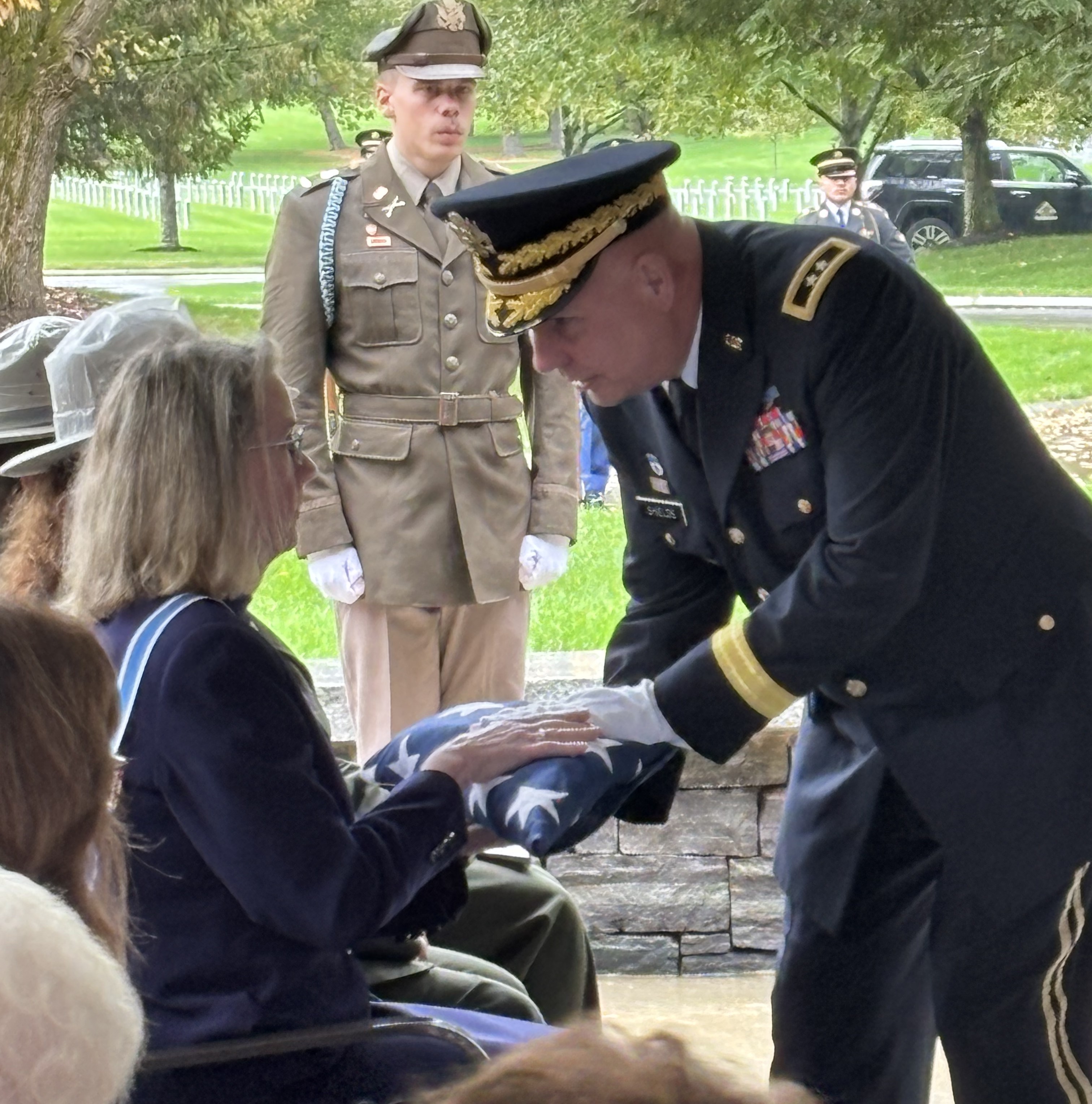
Major General Ray Shields, the adjutant general of New York, presents an American flag to Lisa O’Brian, the regent of the Daughters of the American Revolution in New York state, during a military funeral for unknown Revolutionary War Soldiers who died at the 1776 Battle of Valcour island during an Oct. 13, 2026 ceremony at Gerald BH Solomon Saratoga National Cemetery in Schuylerville, New York. O’Brian accepted the flag, which had draped the casket containing the remains of the Soldiers, as a representative of the families of the Revolutionary War unknowns. (U.S. Army National Guard photo by Lt. Col. Jean Marie Kratzer)
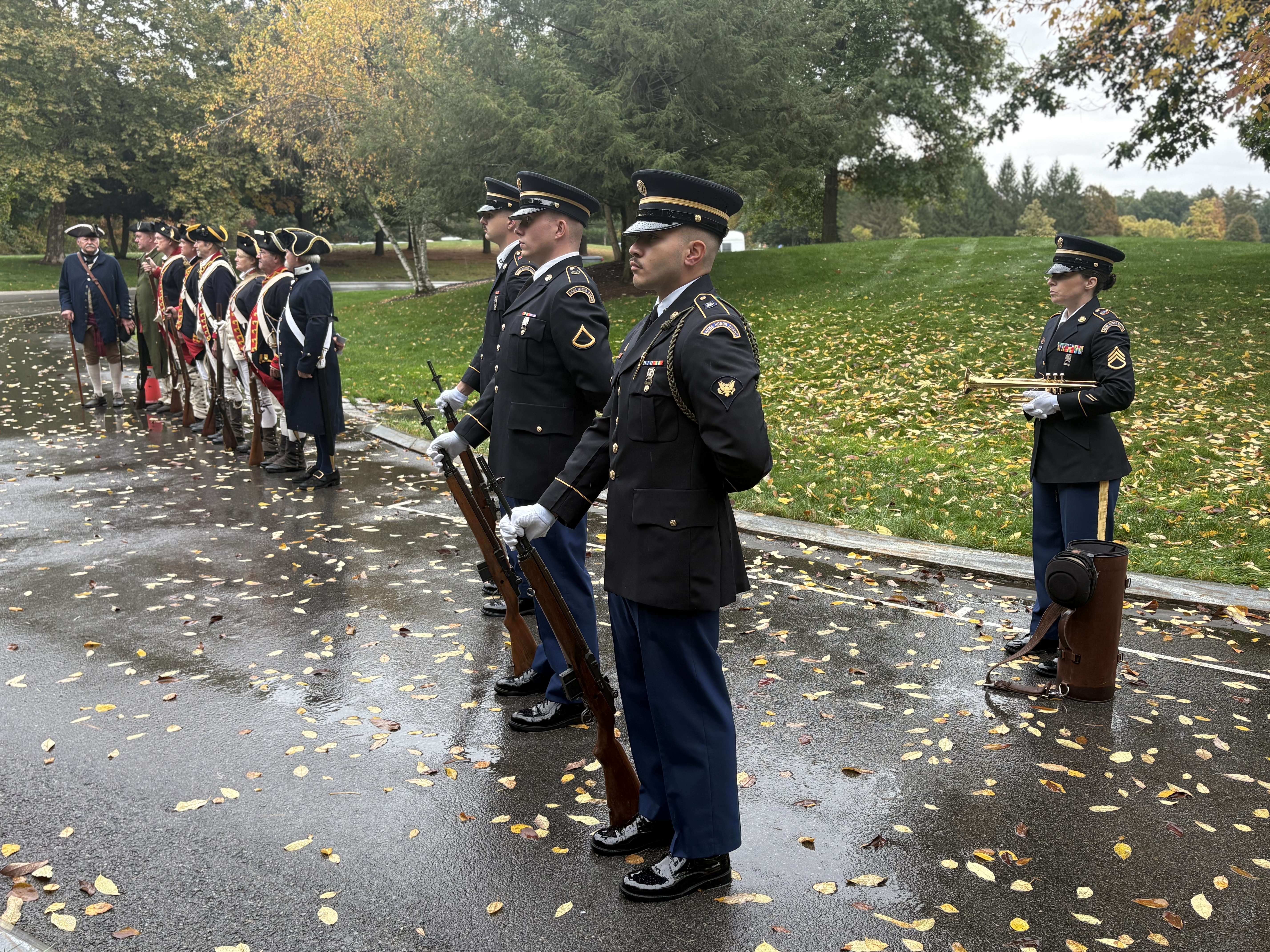
Members of the New York Army National Guard Honor Guard firing party stand at attention, with a contingent of Revolutionary War reenactors in the background, during a military funeral for unknown Revolutionary War Soldier who died at the 1776 Battle of Valcour island during an Oct. 13, 2026 ceremony at Gerald BH Solomon Saratoga National Cemetery in Schuylerville, New York. The Soldiers died during the Battle of Valcour Island on October 11, 1776, which was fought against a British fleet on the waters of Lake Champlain. (U.S. Army National Guard photo by Lt. Col. Jean Marie Kratzer)

New York National Guard
Lt. Col. Jean Kratzer, 518-786-4581Share this Story


Recent News
- Halfmoon resident Eric Underhill promoted to one-star general rank during October 3 ceremony
- Ballston Spa resident Michael Golden, promoted to Lieutenant Colonel in the New York Naval Militia
- New York Army Guard Chief Warrant Officer 4 Victoria Whitley, a New Windsor resident who grew up in Washington, D.C. retires after 35 years of service
- New York National Guard marks birthday of President Chester Arthur with wreath laying ceremony in Albany Rural Cemetery
- NY Army National Guard salutes President Chester Arthur this morning, Monday, October 5 during ceremony at Albany Rural Cemetery
- New York Army Guard Major General Michel Natali, a Watertown native, retires after almost 40 years of service
- New York Army Guard Major General Michel Natali, a Watertown native, retires after almost 40 years of service
- New York Army Guard Major General Michel Natali, a Mechanicville resident, retires after almost 40 years of service
- NY Army National Guard salutes President Chester Arthur during Monday, October 5 ceremony at Albany Rural Cemetery
- Major General Michel Natali, a Mechanicville resident, retires from New York Army National Guard during ceremony this afternoon, Friday, October 2